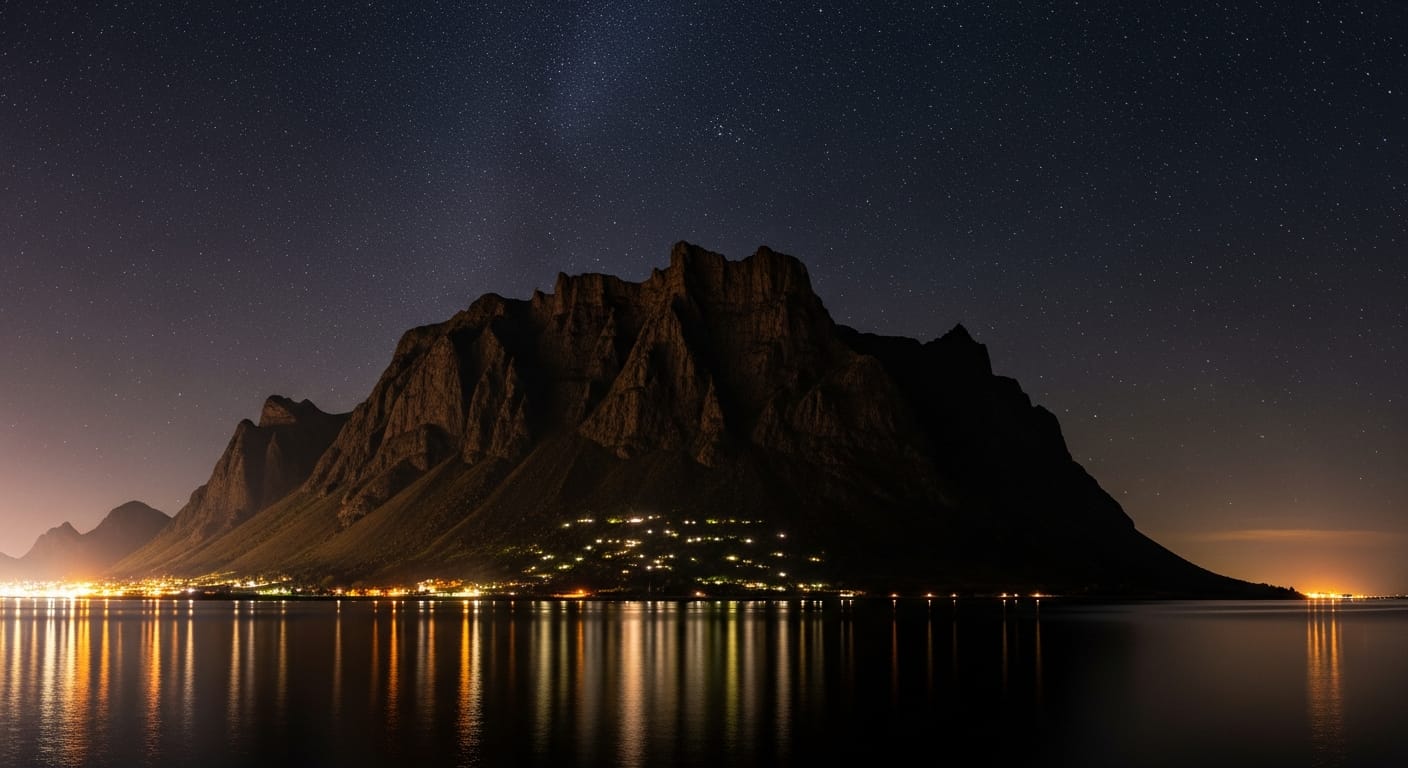
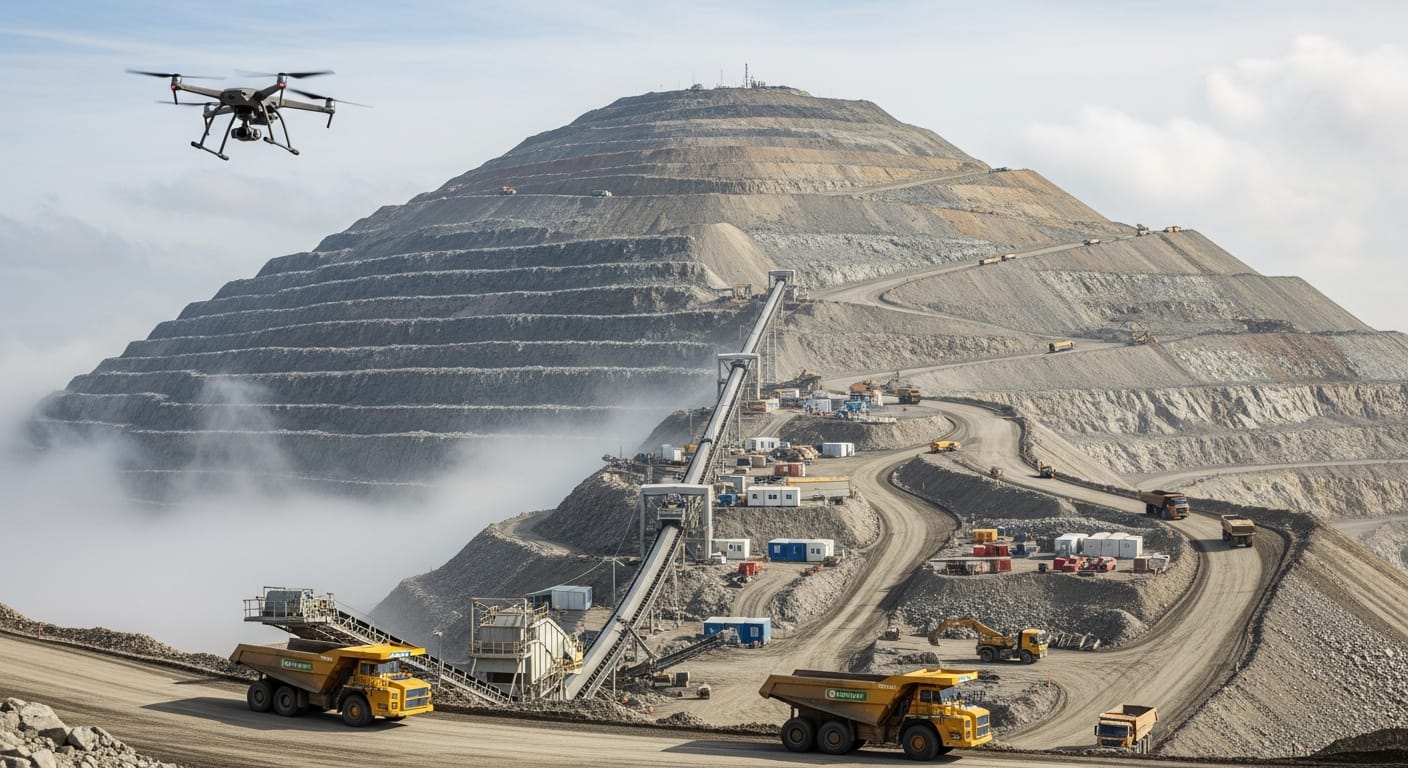
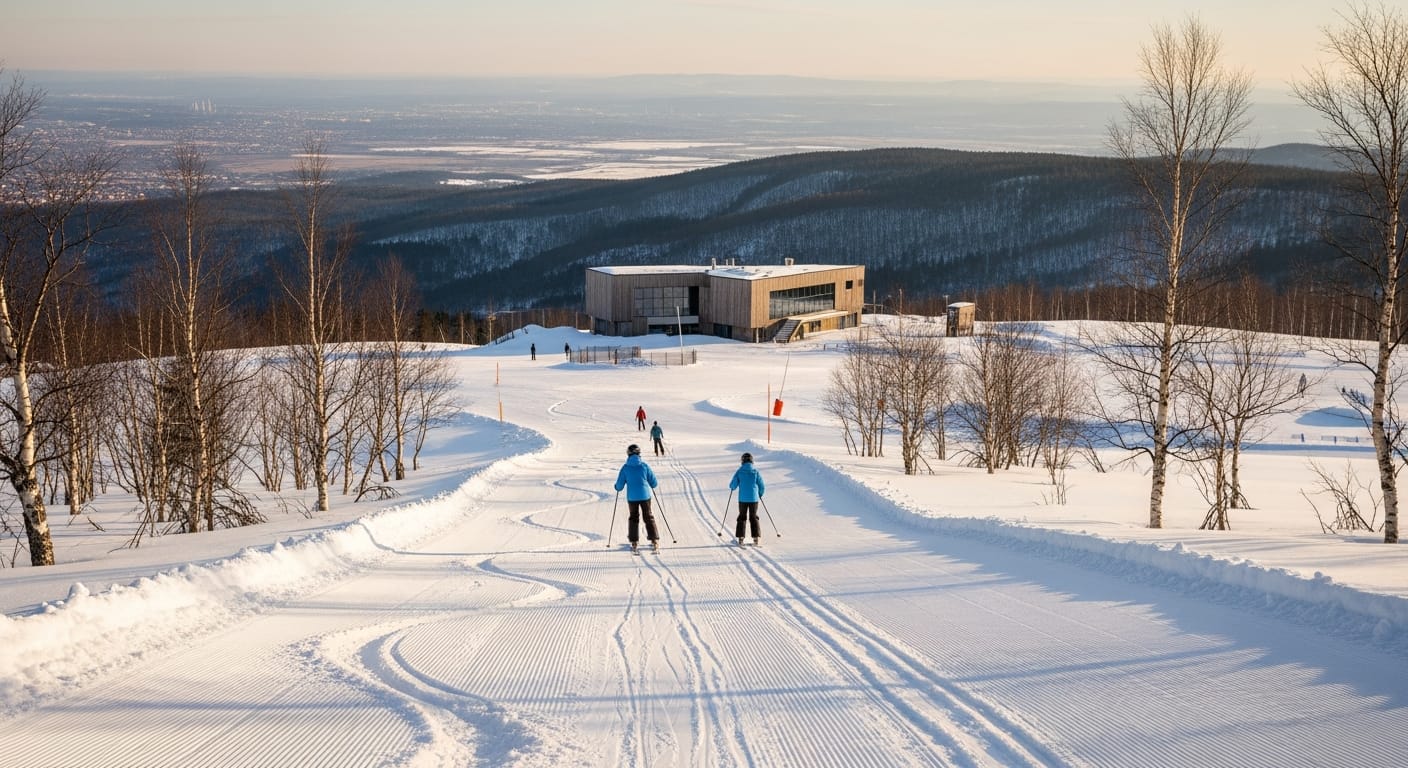
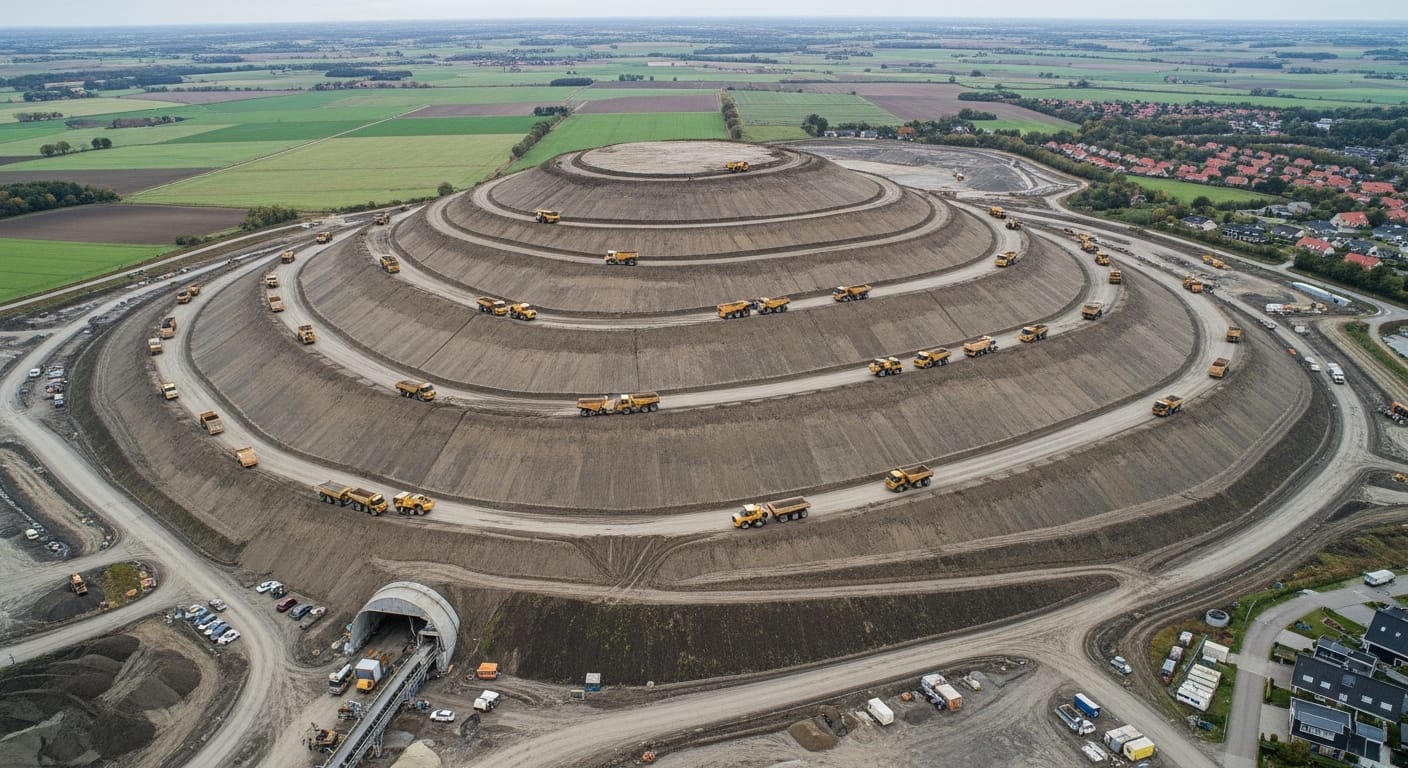
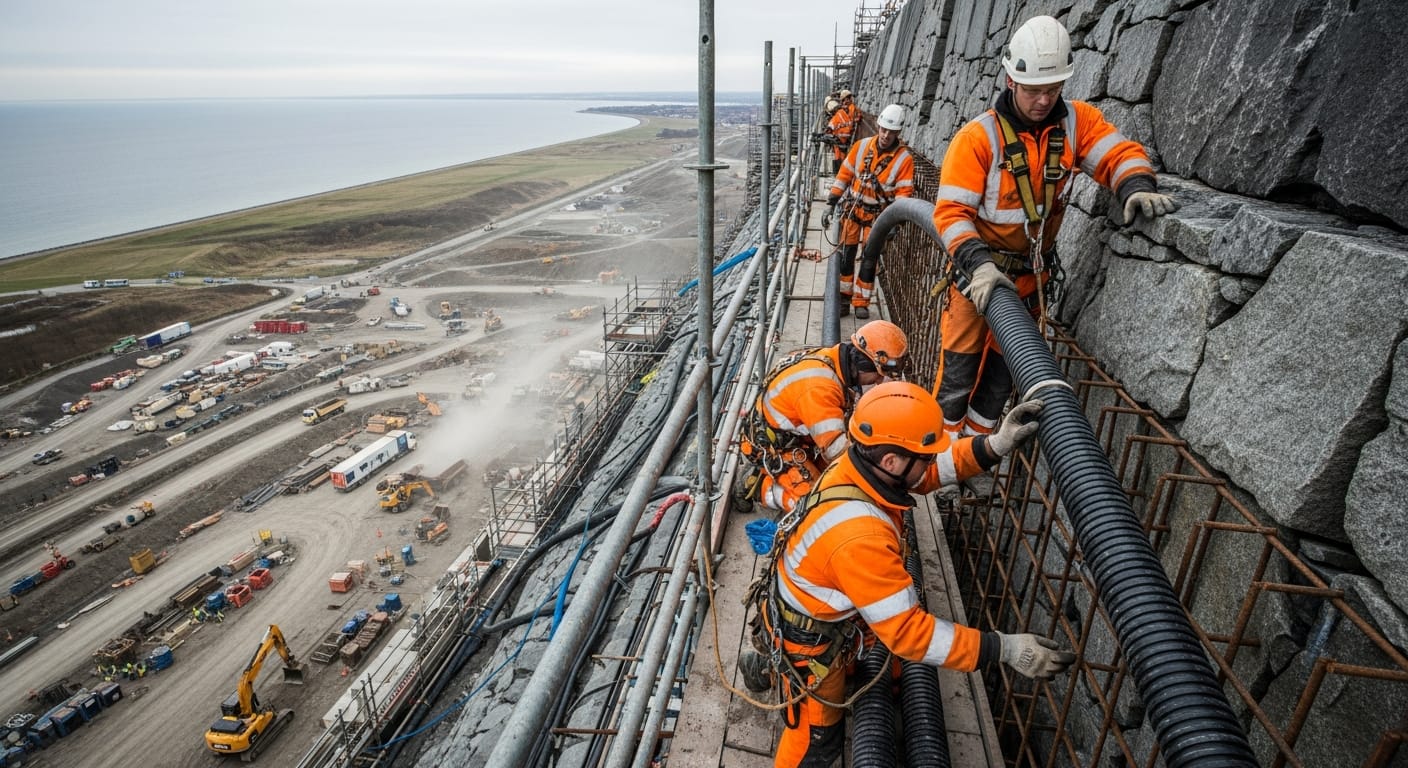
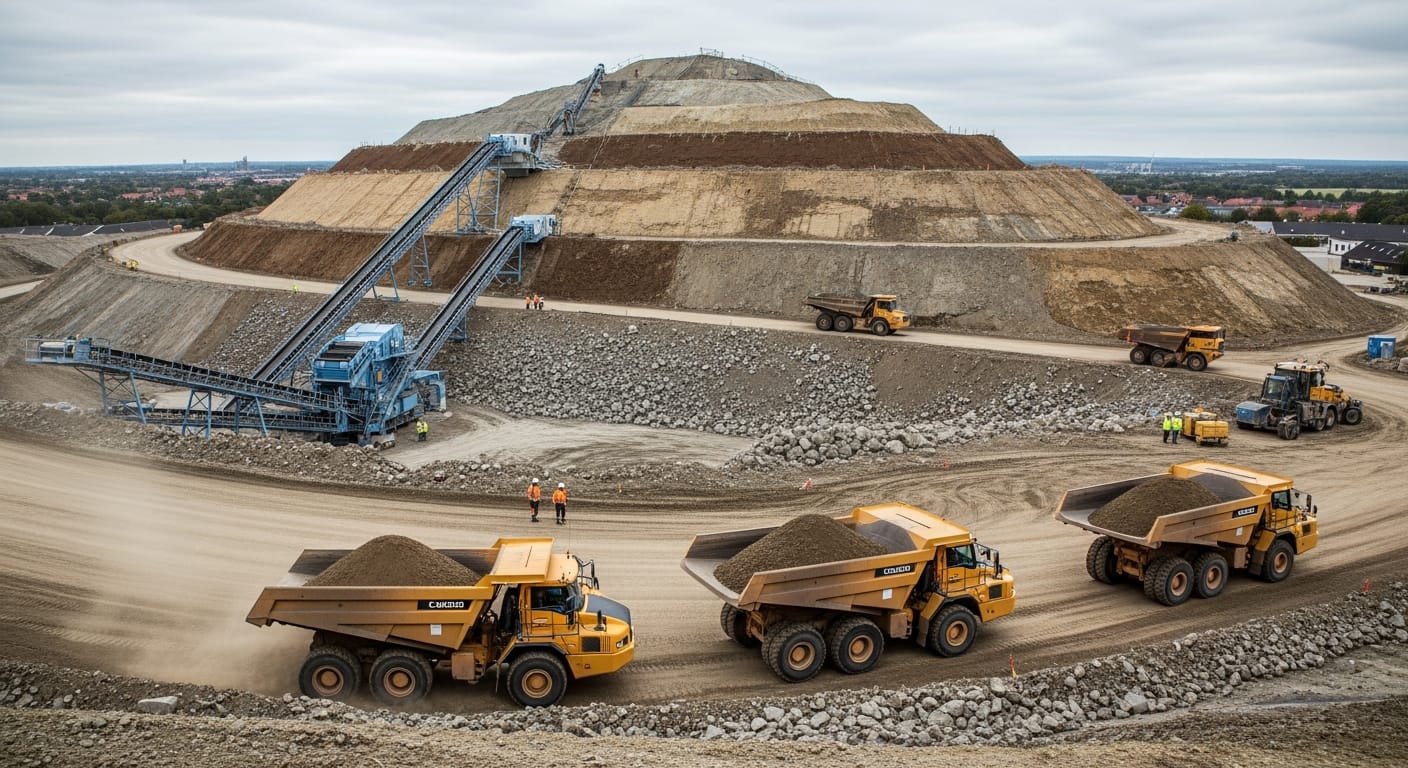
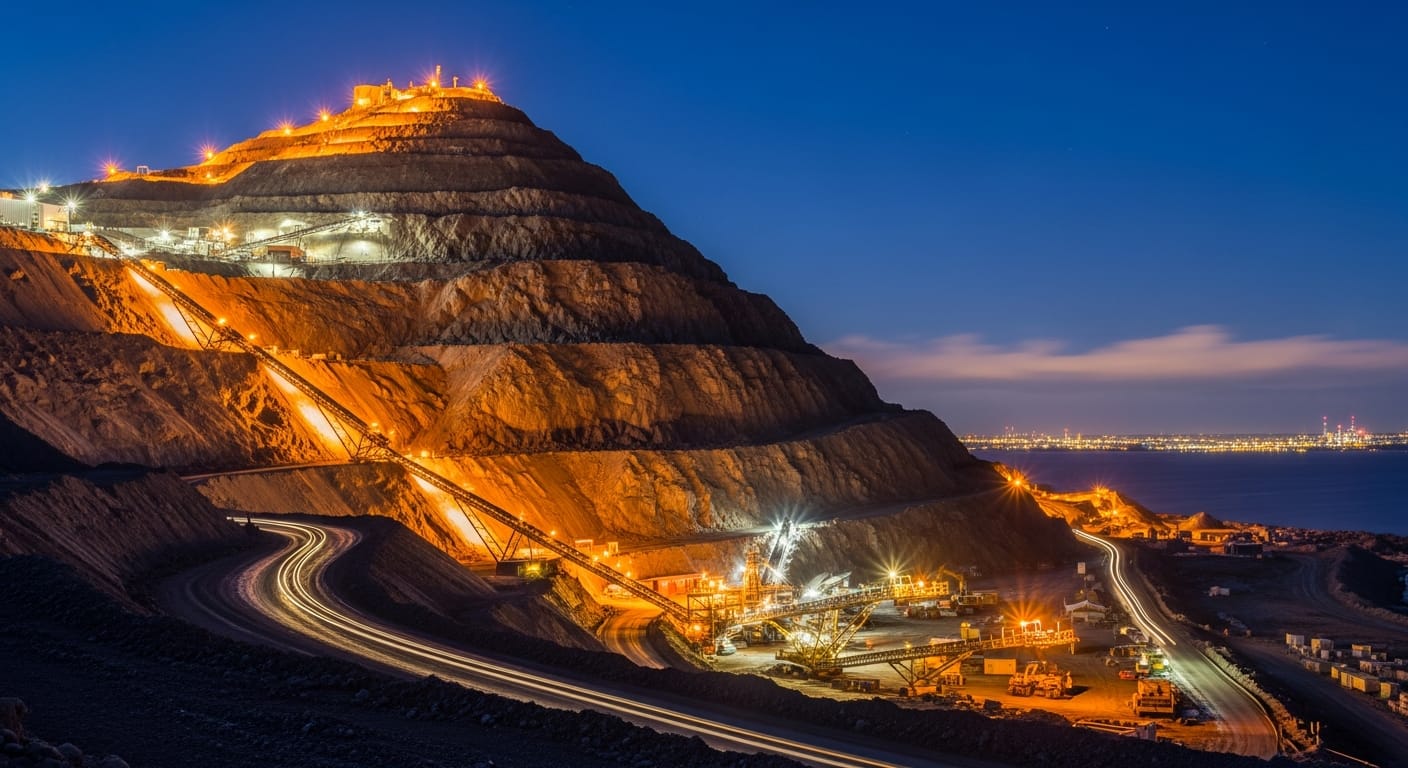
A 3,500-metre mountain on the southern shore of Amager. The most ambitious construction project in human history. A permanent engine of clean energy, tourism, biodiversity, and national identity.
Mount Copenhagen transforms the flattest country in Europe into a nation hosting the highest peak in Northern Europe — taller than anything in Scandinavia, permanently snow-capped, visible from the city centre, generating more clean energy than Denmark consumes, and creating an entirely new economy around altitude.
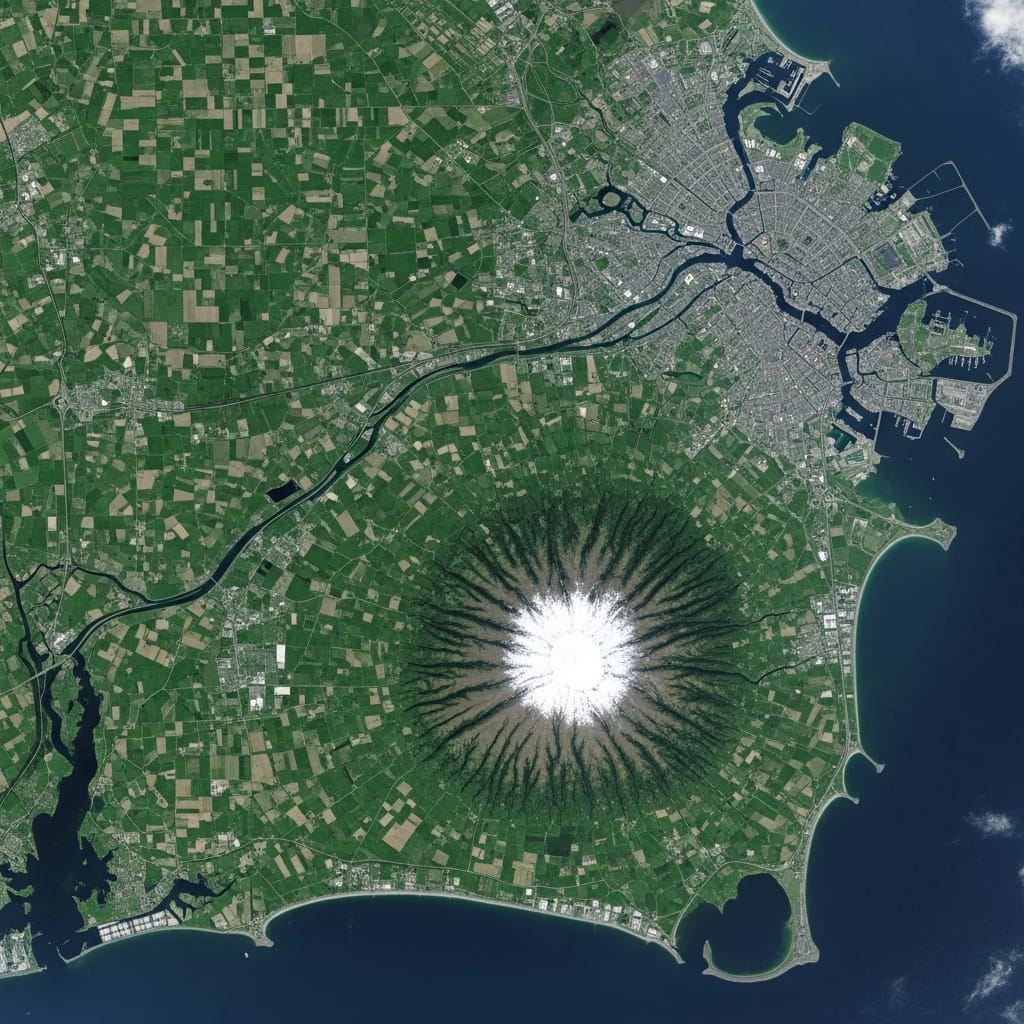
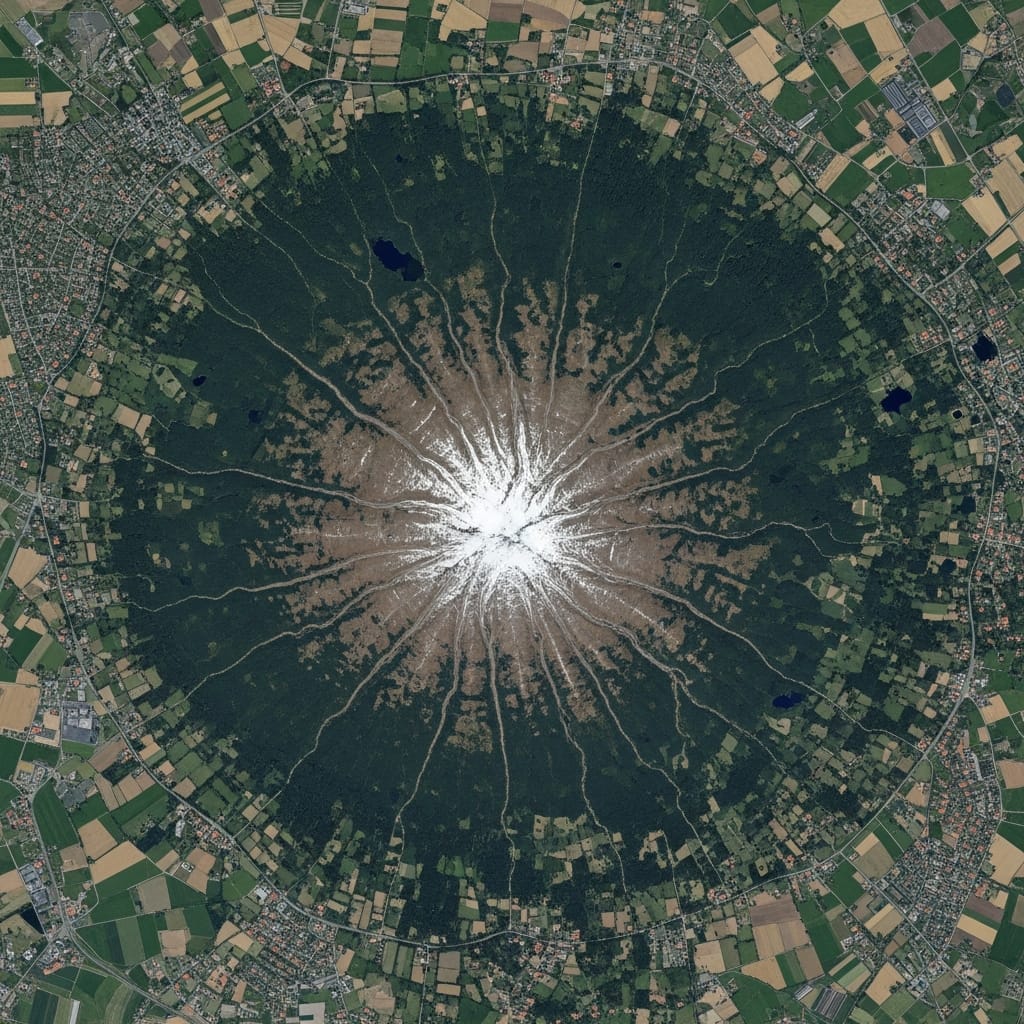
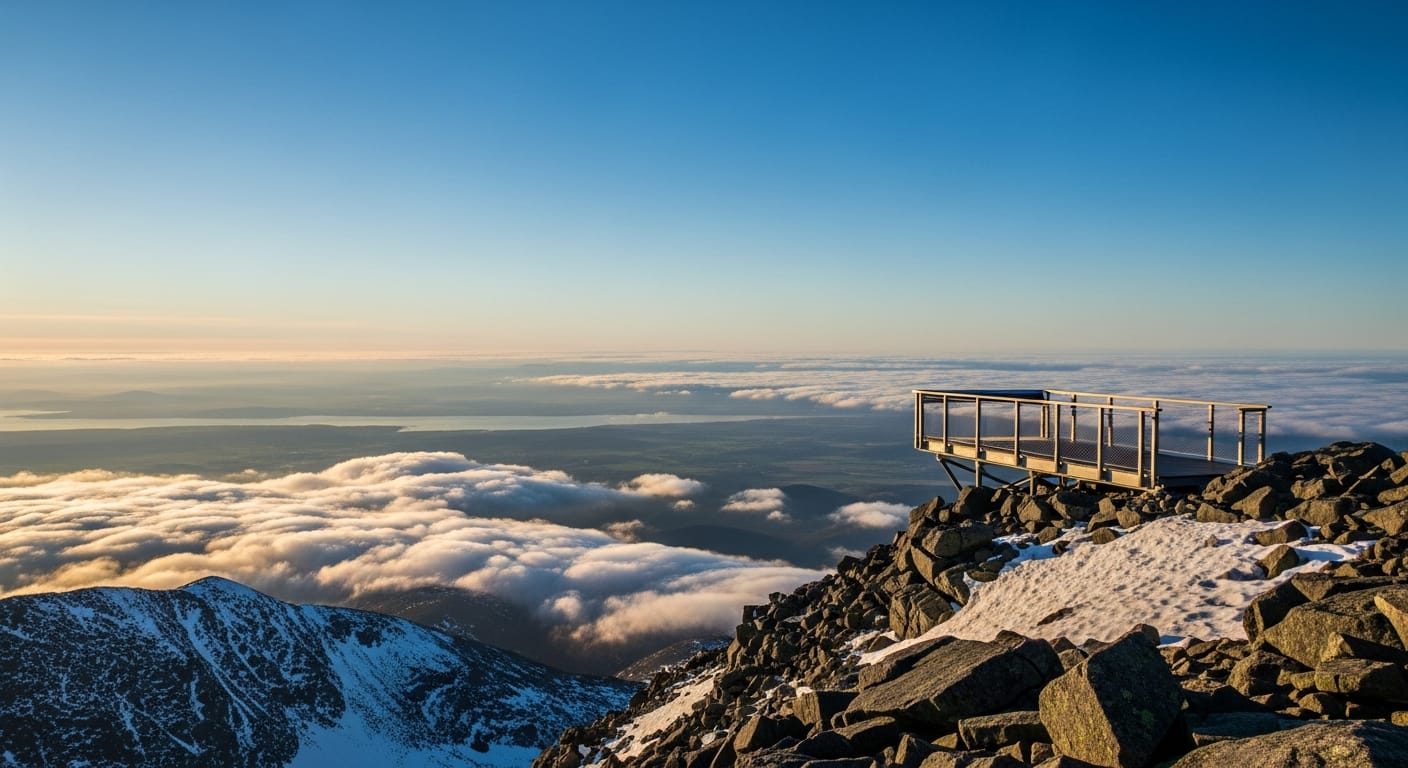
The mountain rises from the southern coastline of Amager, extending into the shallow waters of Køge Bay. Its base circumference of 50 km creates a footprint of approximately 199 km². The summit, at 3,500 metres, carries permanent snow and ice — the only glacial feature in Denmark, and the most southerly significant glacier in mainland Europe outside the Alps.
Denmark’s current highest point is Mollehøj at 170.86 metres. Mount Copenhagen would be 20.5 times taller than anything the country has ever known. From Rådhuspladsen, just 12 km away, the mountain dominates the entire southern horizon. Its green slopes, white summit, and cloud-piercing profile become as iconic to Copenhagen as the harbour, the spires, and the sea.
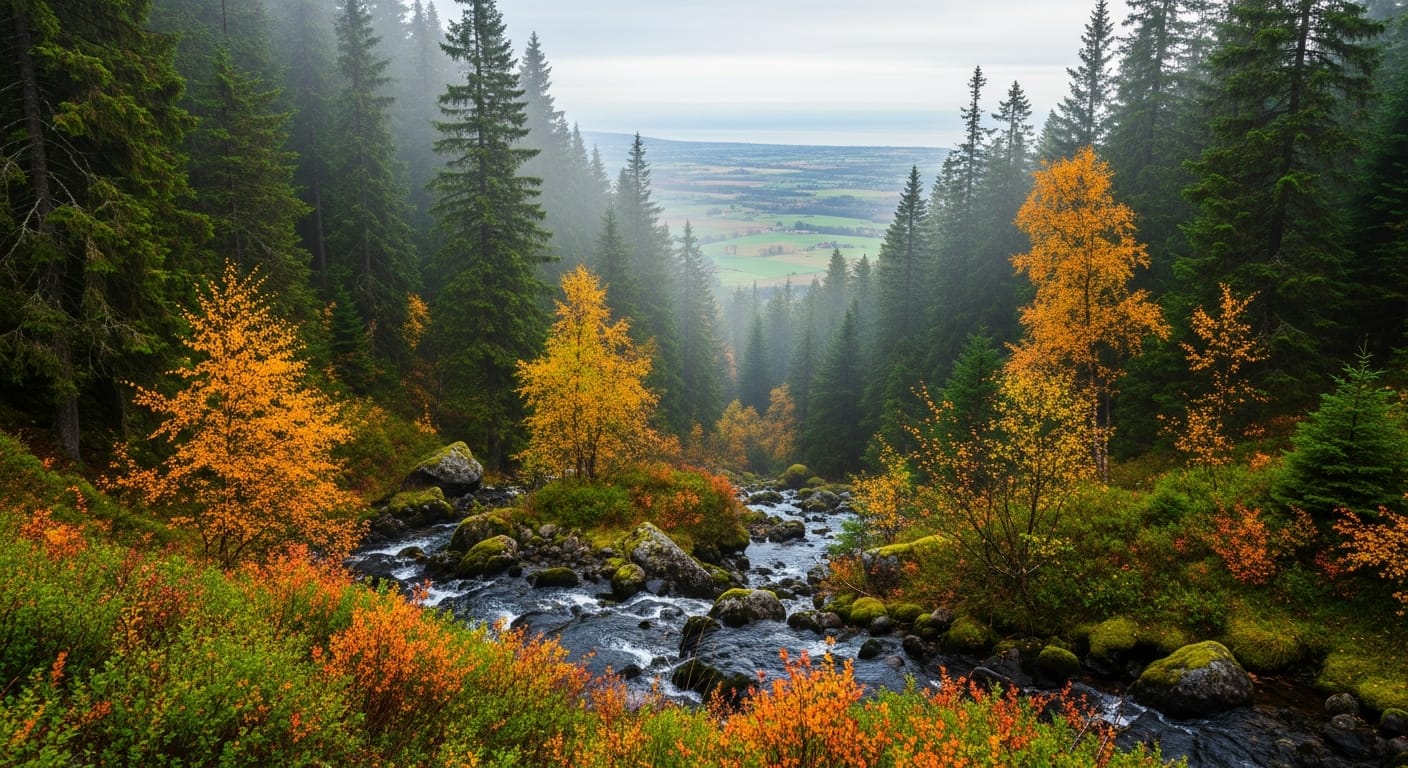
Seven distinct ecosystems emerge across the slopes. Over centuries, reindeer, arctic fox, lynx, elk, and hundreds of bird and plant species colonise the mountain. Denmark gains a world-class ski resort, a renewable energy plant producing 154% of national electricity needs, a scientific research station, and a UNESCO World Heritage candidate. This is not a building. It is a new geography.
The base is centred approximately 12 km south of the city centre. Køge Bay is nowhere deeper than 10 metres, making seabed reclamation and foundation work feasible. The mountain’s northern foothills begin at the Amager coastline; from Amager Strandpark, the forest-covered lower slopes are visible across the water.
Køge Bay is extraordinarily shallow — nowhere deeper than 10 metres. The seabed is sand and clay over chalk bedrock. This makes foundation work orders of magnitude simpler than deep-water construction. The bay is already bordered by built-up suburban areas (Brøndby Strand, Vallensbæk, Ishøj), so transport infrastructure exists. Copenhagen Airport’s flight paths would be rerouted, but the mountain sits south of the current approach corridors.
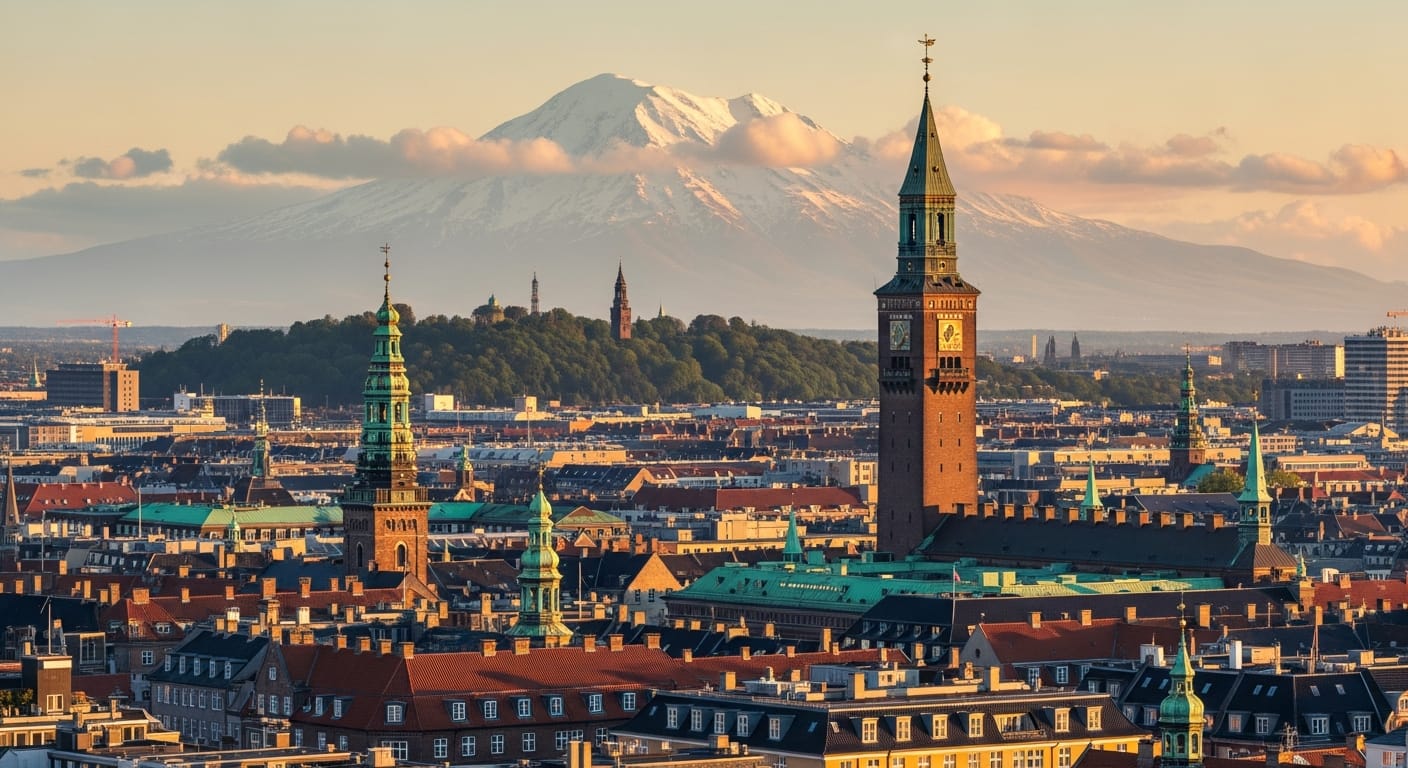
From Rådhuspladsen, the mountain fills the southern sky. The snow-capped summit rises through cloud layers on winter mornings. At 12 km, it subtends roughly 16° of vertical sky — enormous, unmistakable, a permanent feature of Copenhagen’s identity. Compare: Mount Fuji from central Tokyo at 100 km subtends only 2°. Mount Copenhagen would be eight times more visually dominant than Fuji is from Tokyo.
View from central Copenhagen. The Rådhus tower and city spires frame the snow-capped summit of Mount Copenhagen rising 3,500 m to the south.
Mount Copenhagen’s material volume is 1,930× Palm Jumeirah and 2,260× the Three Gorges Dam. Its cost, spread over two centuries, averages $16B/year — comparable to Denmark’s defence budget.
Mount Copenhagen produces 53.8 TWh of electricity annually — 154% of Denmark’s current consumption. It simultaneously stores energy, heats the city, and produces green hydrogen. Total energy infrastructure capex: $74 billion. Annual gross revenue: $3.0 billion. Payback period: 25–30 years on the energy infrastructure alone.
Energy production starts in Phase 1 — not Phase 5
This is critical: you do not wait for a 3,500 m mountain to start generating power. The moment the base reaches 200–300 m, energy production begins. Wind turbines on the first completed ridgelines. Solar arrays on the first south-facing terraces. Water reservoirs collecting rainfall and runoff from the construction surface, feeding small hydroelectric plants. By Year 30, with the mountain at ~500 m, the project is already generating 2–4 TWh/year — enough to power 600,000 homes and partially fund ongoing construction. By Year 60, at ~1,200 m, output reaches 15–20 TWh/year. The mountain pays its own way from early in the build.
| Year | Mountain height | Wind turbines | Solar installed | Hydro reservoirs | Annual output |
|---|---|---|---|---|---|
| Year 15 | ~100 m | 20 (onshore class) | 2 km² | 1 small (0.5M m³) | 0.5 TWh |
| Year 30 | ~350 m | 80 | 8 km² | 3 reservoirs | 3.2 TWh |
| Year 50 | ~700 m | 180 | 25 km² | 5 reservoirs, 800 m head | 10.5 TWh |
| Year 80 | ~1,500 m | 350 | 60 km² | 7 reservoirs, 1,400 m head | 28 TWh |
| Year 150 | ~3,000 m | 480 | 90 km² | Full system, 3,000 m head | 48 TWh |
| Completion | 3,500 m | 500 | 100 km² | Full system + H&sub2; | 53.8 TWh |
Cumulative energy revenue during construction: Assuming a linear ramp from 0.5 TWh/yr at Year 15 to 53.8 TWh/yr at Year 200, cumulative energy revenue over the 200-year construction period exceeds $700 billion — covering approximately 22% of total construction cost from energy alone, before the mountain is even finished.
Wind speed increases dramatically with altitude. At sea level in Denmark, average speeds are 5–7 m/s. At 3,500 m, sustained averages reach 15–20 m/s, with power density exceeding 2,100 W/m² — roughly 15× the sea-level value. The mountain creates its own wind through orographic forcing: air is deflected upward over the slopes, creating accelerated flow at ridgelines. 500 next-generation 15 MW turbines are installed at elevations between 800 and 3,200 m, along ridgelines and engineered terraces. Capacity factor: 45%, significantly above the Danish onshore average of 28% and rivalling offshore performance. Annual revenue from wind alone: $1.63 billion at €50/MWh.
Why 45% capacity factor? Danish onshore wind averages ~28%. Danish offshore (Horns Rev, Kriegers Flak) achieves 40–50%. Mount Copenhagen’s turbines operate at altitude-equivalent wind speeds with no marine corrosion. At 2,000 m, mean wind speed is ~13 m/s; at 3,000 m, ~17 m/s. Wind power scales with the cube of velocity: doubling speed yields 8× power. The altitude advantage is enormous and permanent.
The mountain’s south-facing slopes provide 100 km² of tilted surface optimal for photovoltaics. At altitude, solar irradiance increases 10–15% per 1,000 m due to reduced atmospheric absorption, and cooler ambient temperatures improve PV cell efficiency by ~0.4%/°C below standard test conditions. Installed capacity: 22 GW peak across the south and southwest faces, using agrivoltaics at lower elevations (allowing grazing and vegetation beneath elevated panels) and conventional arrays above the treeline. Annual revenue: $1.33 billion.
Current panel efficiency: 22%. By 2050: 30–35% (perovskite tandems). By 2080: 40%+ (multi-junction). As panels are replaced every 25–30 years over the project lifetime, the same 100 km² produces progressively more energy. At 35% efficiency, annual solar output rises to 38 TWh. At 40%: 44 TWh. Total mountain output could reach 74 TWh by the project’s second century — over 200% of Denmark’s needs.
A 10-million-m³ reservoir excavated into the summit plateau at 3,200 m, paired with lower reservoirs at the base (200 m), provides 3,000 m of hydraulic head. At 85% round-trip efficiency, each cycle stores 69.5 GWh — approximately two full days of Denmark’s average electricity demand. The system runs 250+ cycles per year. No battery installation on Earth approaches this capacity. The mountain is a gravity battery that never degrades, never needs replacing, and operates for millennia.
The mountain’s 464-billion-tonne rock mass maintains a stable internal temperature of 8–12°C at 50–100 m depth from the surface. Water circulated through 200+ km of internal tunnels extracts this thermal energy and delivers it to Copenhagen’s district heating network. The mountain essentially replaces fossil-fuel CHP plants. Additional thermal applications: cold-air drainage from high altitude provides natural cooling for data centres at the base (saving ~€50M/year in cooling costs for a hyperscale facility).
Excess electricity (particularly overnight wind surplus) powers electrolysis plants at the mountain’s base. Hydrogen is stored in pressurised caverns within the mountain itself — natural geological storage at zero marginal cost. At current green hydrogen prices (~€4–6/kg), annual hydrogen revenue: $800M–$1.2B. As hydrogen infrastructure matures and demand from shipping, aviation, and heavy industry grows, this becomes one of the mountain’s most valuable revenue streams.
| Source | Installed capacity | Annual output | Capex | Annual revenue |
|---|---|---|---|---|
| Wind (500 × 15 MW) | 7.5 GW | 29.6 TWh | $5B | $1.63B |
| Solar (100 km²) | 22 GW peak | 24.2 TWh | $11B | $1.33B |
| Pumped hydro | 5 GW | Storage / arbitrage | $20B | $0.3B |
| District heating | — | 5–10 TWh thermal | $8B | $0.4B |
| Green hydrogen | 2 GW electrolyser | 200,000 t H&sub2; | $6B | $1.0B |
| Grid connection | — | Transmission | $24B | — |
| Total energy | 53.8 TWh + thermal + H&sub2; | $74B | $4.66B |
Energy payback: 16 years. At $4.66B/year gross revenue against $1.35B/year O&M, net annual energy income is $3.31B. The $74B energy infrastructure pays for itself in ~22 years, well within the first turbine generation’s operational life.
Mount Copenhagen is not a cost centre. It is an economic engine that generates $8.2B/year from six revenue streams, creating a permanent GDP uplift equivalent to adding 2% to Denmark’s economy.
| Revenue stream | Annual revenue | Basis |
|---|---|---|
| Electricity sales (wind + solar) | $2.96B | 53.8 TWh at €50/MWh avg. wholesale price |
| Green hydrogen | $1.00B | 200,000 t at €4.50/kg (declining over time) |
| Tourism & recreation | $2.20B | Skiing, hiking, mountain biking, lodging, lift tickets, F&B |
| District heating | $0.40B | Thermal supply to Copenhagen network |
| Pumped hydro arbitrage | $0.30B | Buy-low/sell-high on Nord Pool |
| Real estate & commercial leases | $0.80B | Foothill development, data centres, research campus |
| Research & licensing fees | $0.25B | Scientific access, patent licensing (see below) |
| Media & branding | $0.30B | Documentary rights, naming rights, merchandise |
| Total | $8.21B |
Denmark’s tourism sector currently contributes DKK 180B (~$26B) to GDP and supports 191,000 jobs. Mount Copenhagen would add an entirely new category — mountain tourism — that Denmark has never had. Comparable benchmarks:
Austria’s ski sector contributes €12.5B to the economy (6.2% of GDP). France’s Alps generate €12B in annual ski tourism revenue. Mount Copenhagen, as the only ski resort within 500 km of 20 million Northern Europeans (Denmark, northern Germany, southern Sweden), would capture significant market share. Conservative estimate: 3–5 million skier visits/year at €150 average spend = €450–750M in ski-specific revenue.
Alpine tourism in Europe generates €50B annually, with 60–80 million visitors to the Alps each year. Mount Copenhagen offers hiking, mountain biking, trail running, paragliding, and wildlife tourism across seven biomes. Year-round operation (unlike seasonal Alpine resorts) with 8–12 million annual visitors generating €120–180 average spend.
The world’s only artificial mountain. The highest point in Northern Europe. Permanent snow 12 km from a capital city. Seven biomes in one hike. Arctic foxes and reindeer visible from a country with no natural elevation. The “see it to believe it” factor alone drives millions of curiosity visits in the first decades. Mount Copenhagen becomes the most Instagrammed location in Scandinavia.
Denmark is already one of the world’s strongest national brands — known for design, hygge, sustainability, and happiness. Mount Copenhagen adds “the country that built a mountain” to that identity. The branding value is comparable to what the Sydney Opera House did for Australia, what the Burj Khalifa did for Dubai, or what the space program did for the United States. It redefines what a small nation of 6 million people can achieve.
The Netflix effect
A construction project spanning 200+ years is the ultimate long-format documentary subject. Imagine a multi-season series following the project from parliamentary vote to first summit — each season covering a decade of construction, the human stories of the engineers and ecologists, the political dramas, the technical breakthroughs. This is “The Crown” meets “MegaStructures” meets “Planet Earth.” Media rights for such a franchise: conservatively $50–100M/year, potentially much more as the project becomes the defining cultural narrative of the 21st century. Mount Copenhagen is on everybody’s algorithm.
The Manhattan Project created the nuclear industry. Apollo created the semiconductor industry. Mount Copenhagen will create the next generation of construction, materials, and environmental technology. Estimated IP value over 100 years: $200–500 billion.
R&D: $3B. Compaction to 200+ m depth. Market: every dam, bridge foundation, and earthquake-resistant building in the world. Global addressable market: $50B/year. Danish-held patents could generate $500M–$1B/year in licensing.
R&D: $8B. 400-tonne electric autonomous vehicles. Market: mining, quarrying, port logistics. Estimated market creation: $30B/year. Denmark becomes the world leader in autonomous heavy vehicles, exporting technology worth $2–5B/year.
R&D: $5B. 200,000 t/hr throughput over 3,500 m elevation. Applications: mining, bulk logistics, material handling. This technology alone could transform how the world moves raw materials.
R&D: $2B. Synthetic soil matrices with living microbiomes. Applications: post-mining restoration, desert greening, Mars/Moon terraforming R&D. The space agencies alone would pay billions for proven altitude-soil technology.
R&D: $4B. Bacterial calcite-precipitation, graphene reinforcement. The global concrete market is $650B/year. If Mount Copenhagen’s concrete technology captures 2% market share through licensing: $13B/year revenue.
R&D: $5B. Integrated wind/solar/hydro at altitude. Applicable to every mountainous country on Earth. Export packages of “mountain energy systems” to Nepal, Chile, Switzerland, Norway — a new Danish export category.
Total IP revenue estimate
Conservative: $2–5B/year from patent licensing and technology exports once the key inventions are proven and commercialised (Year 20+). Over 100 years, cumulative IP value: $200–500B. This alone could cover 6–15% of the total project cost — before counting the energy, tourism, or branding returns.
$3.2 trillion over 200 years is $16B/year. Denmark’s GDP is ~$400B. This requires an international financing architecture unlike anything built before — but not without precedent. The EU itself is a multi-nation, multi-decade infrastructure project.
| Source | Share | Annual contribution | Mechanism |
|---|---|---|---|
| Danish state (sovereign commitment) | 25% | $4.0B/yr | Dedicated tax, green bonds, sovereign wealth allocation |
| EU infrastructure fund | 15% | $2.4B/yr | Green Deal successor programme, cohesion funds |
| International sovereign investors | 20% | $3.2B/yr | Norway’s GPFG, Abu Dhabi’s ADIA, Singapore’s GIC |
| Private infrastructure funds | 15% | $2.4B/yr | BlackRock, Brookfield, Macquarie — long-duration infra |
| Project revenue (self-financing) | 15% | $2.4B/yr | Energy revenue from Year 40+, escalating over time |
| Technology licensing revenue | 5% | $0.8B/yr | Patent licensing from Year 20+, escalating |
| Green bond issuance | 5% | $0.8B/yr | AAA-rated sovereign green bonds, 100-year duration |
| Total | 100% | $16.0B/yr |
$4.66B/year in energy revenue against $74B capex = 6.3% annual return, inflation-protected, for an asset with an indefinite lifespan. No decommissioning cost. No fuel cost. This beats any infrastructure bond on the market.
The mountain’s foothills become the most valuable real estate in Scandinavia. Mountain-view properties within 5 km of the base — homes, hotels, commercial space, research campuses, data centres. Land value appreciation alone could generate $50–100B over the project lifetime for early investors.
Naming rights for individual features (ridgelines, lakes, refuges, observation decks) are worth $10–50M each. A “founding sponsor” tier for major corporations: $500M–$1B for permanent naming rights on the mountain’s primary ski resort, summit observatory, or base village. This is the Super Bowl of branding — permanent, global, and growing.
The project requires an independent, constitutionally protected governing body — modelled on central banks and the Vatican’s Fabbrica di San Pietro, which has managed St. Peter’s Basilica for 500 years. The Mount Copenhagen Authority (MCA) would have: a 25-year renewable charter protected by constitutional amendment; an independent board with Danish, EU, and international investor representation; dedicated revenue streams ring-fenced from annual government budgets; and the power to issue its own bonds backed by the mountain’s energy revenue.
Mount Copenhagen is not just a construction project. It is a 200-year narrative — the kind of story that defines civilisations. The media and cultural production around it becomes a revenue stream and a branding multiplier.
A multi-decade episodic documentary follows the project from initial geological surveys through each construction phase. Season 1: “The Decision” — the political battle to approve the project. Season 2: “Foundations” — the engineering challenge of building on Danish chalk. Season 5: “First Snow” — when the mountain reaches 1,500 m and receives its first natural snowfall. Season 12: “The Forest” — when the first wolves or lynx are spotted on the boreal slopes. Each decade provides a new season, a new set of human stories. Netflix, Disney+, or a dedicated streaming platform. Rights value: $50–150M/year.
Artists-in-residence programme at each elevation zone. Annual mountain music festival at 1,500 m with the best acoustics in Scandinavia. Land art installations integrated into the construction process. A permanent museum at the base documenting every phase. Literary and film commissions. Mount Copenhagen becomes a cultural institution as much as an engineering one. Denmark’s cultural GDP grows as the mountain attracts creative talent from around the world.
A 3,500 m mountain at 55.7°N compresses ecosystems normally spread across 2,500 km of latitude into a single slope. The Scandinavian treeline sits at approximately 900–1,200 m in southern Norway. The permanent snowline at this latitude: approximately 2,200–2,800 m.
| Line item | Cost | Share |
|---|---|---|
| R&D and technology development | $50B | 1.6% |
| Foundation (piling, raft, seabed reclamation) | $200B | 6.3% |
| Base mass (0–500 m) | $900B | 28.1% |
| Mid mass (500–1,500 m) | $950B | 29.7% |
| Upper mass (1,500–2,500 m) | $550B | 17.2% |
| Summit (2,500–3,500 m) | $350B | 10.9% |
| Energy infrastructure | $74B | 2.3% |
| Ecological development | $50B | 1.6% |
| Transport infrastructure | $76B | 2.4% |
| Total | $3.2T | 100% |
Self-sustaining by Year 60
Energy revenue begins Year 40, tourism revenue Year 50, IP licensing Year 20. By Year 60, the mountain generates $5–8B/year against a construction burn rate of $16B/year. By Year 100, revenue exceeds construction cost. By Year 150, the mountain is fully self-financing and turning a profit that services the original debt.
The engineering is extrapolation, not invention. The materials exist. The energy to do it exists. The economic return makes it one of the most productive infrastructure investments conceivable over a 500-year horizon.
What makes Mount Copenhagen unprecedented is not its cost or scale, but its ambition: to permanently reshape the geography of a nation, to create new ecosystems from bare rock, and to prove that the greatest construction projects need not be monuments to war or faith — but to the belief that we can make the world more interesting than we found it.